Balance is not a niche skill. It is a baseline function of how well your body controls itself.
Most people never measure it.
Most people assume they are “fine.”
Most people are wrong.
This test exposes that gap in under a minute.
What Is “Balance Age”?
Balance age is a functional estimate of how well your body maintains stability compared to expected control levels across age ranges.
It is determined by:
- Proprioception (your body’s position awareness)
- Neuromuscular control (how quickly and precisely muscles respond)
- Joint stability (ankle, knee, hip alignment)
- Core coordination (not just strength, but control under instability)
It is possible to be young and have poor balance.
It is possible to be older and have excellent control.
The 60-Second Balance Test
Setup
- Stand barefoot on a flat surface
- Place hands on hips
- Fix your gaze on a point in front of you
Step 1 — Eyes Open
- Lift one foot slightly off the ground
- Hold the position
Step 2 — Eyes Closed
- Close your eyes
- Start timing
- Stop when your foot touches the ground or you lose control
Here’s How to Read Your Result
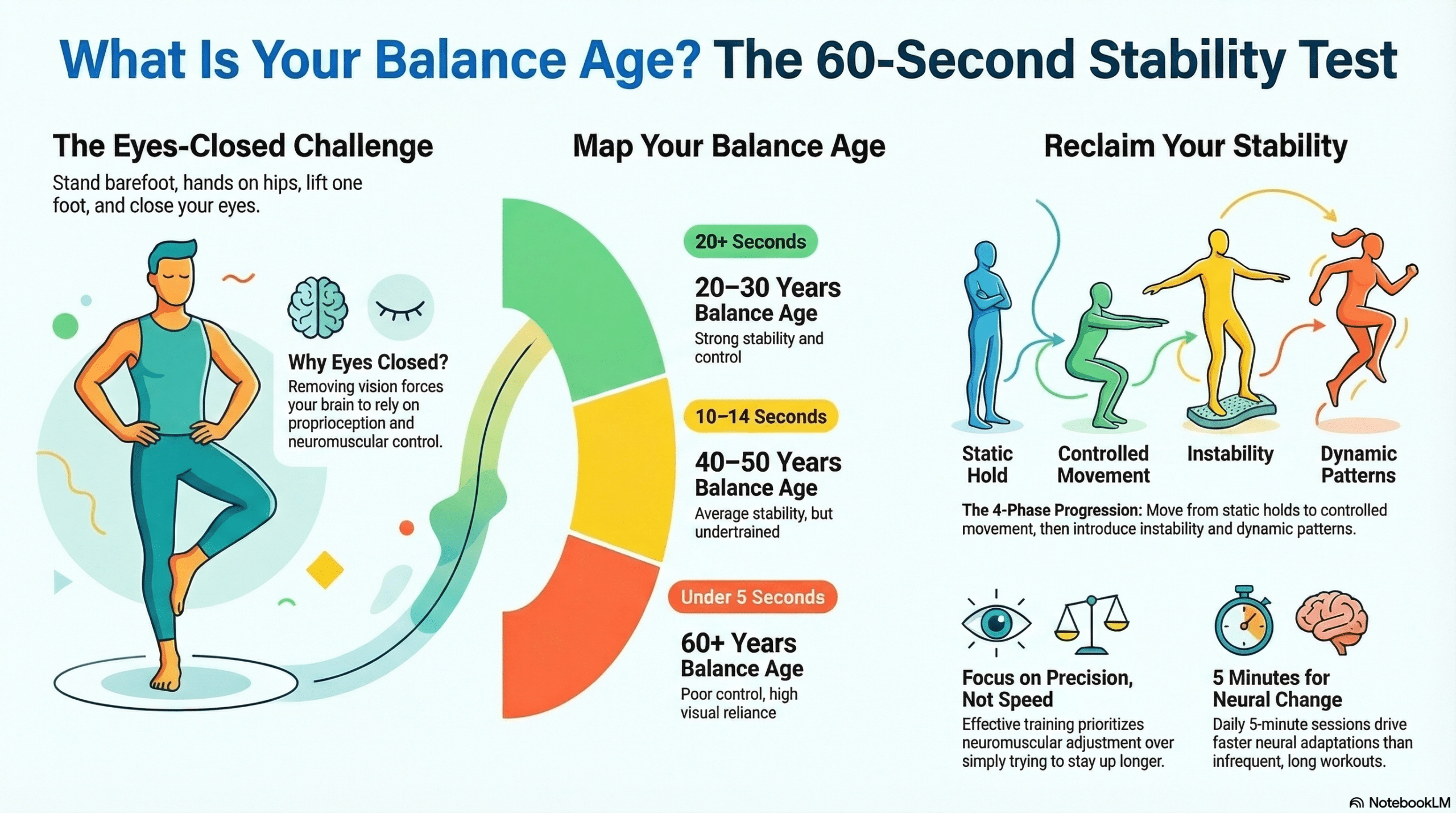
Your balance age is based on how long you can hold a single-leg stance with your eyes closed.
Once vision is removed, your body must rely on:
- proprioception
- neuromuscular control
- joint stability
- coordinated muscle response
That makes this a more accurate measure than eyes-open balance.
Balance Age Scorecard
| Eyes-Closed Hold Time | Balance Age | Interpretation |
|---|---|---|
| 20+ seconds | 20–30 years | Strong stability and control |
| 15–19 seconds | 30–40 years | Above average, but not optimal |
| 10–14 seconds | 40–50 years | Average stability, undertrained |
| 5–9 seconds | 50–60 years | Clear stability deficit |
| Under 5 seconds | 60+ years | Poor control, high reliance on vision |
What Your Result Actually Means
If your result is below 10 seconds, the issue is not strength.
It indicates:
- weak stabilizer muscles
- delayed neural response
- poor ankle and hip coordination
- dependence on visual input for balance
Most people rely on their eyes without realizing it.
Remove vision, and control collapses.
Why Balance Declines After 25
This is not biological aging. It is lack of exposure.
Three consistent patterns:
- Stability is not trained. Workouts focus on force output, not control.
- Movement becomes predictable. Machines, fixed paths, repetitive motion.
- The nervous system loses precision. Without instability, coordination deteriorates.
The result is a gap between strength and control.
Is Poor Balance a Sign of a Weak Core?
Yes, but not in the visible sense.
Core weakness here means:
- poor anti-rotation control
- lack of coordination between hips and spine
- inability to stabilize under shifting load
Visible abs do not guarantee control.
How to Improve Your Balance at Home
Phase 1 — Static Control
- Single-leg holds (eyes open → closed)
- Use support if necessary
Phase 2 — Controlled Movement
- Shift weight slowly
- Focus on precision, not speed
Phase 3 — Light Instability
- Introduce a slightly unstable surface
- Maintain control, not duration
Phase 4 — Dynamic Stability
- Add reach, rotation, or squat patterns
- Keep balance under movement
Where a Balance Board Fits In
At a certain point, bodyweight drills stop being enough.
You need a controlled form of instability that forces your body to adapt without excessive risk.
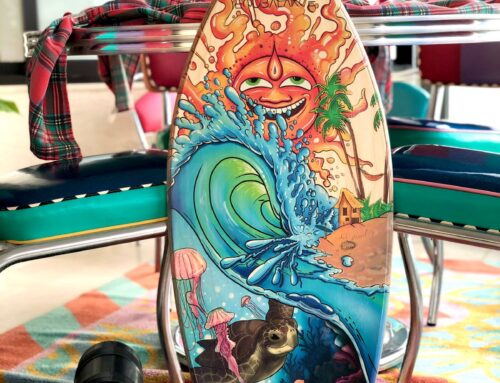
This is where the Equibalance Balance Board becomes relevant.
Unlike static floor exercises, a board:
- continuously challenges your stabilizer muscles
- forces real-time neuromuscular adjustments
- improves proprioception under movement
- exposes weaknesses you cannot feel on stable ground
A well-designed board does not make training easier.
It makes feedback immediate.
Why Equibalance Accelerates Progress
Equibalance is built specifically for controlled instability training.
It allows you to:
- start with low-level instability (beginner-safe)
- progress into dynamic balance control
- train both static holds and movement patterns
- build coordination, not just endurance
This turns balance training from random effort into structured progression.
How to Use It (Beginner Flow)
- Stand with support → remove support gradually
- Practice slow weight shifts before full balance
- Introduce short hold intervals (5–10 seconds)
- Progress into controlled movement, not tricks
The goal is not to stay on the board longer.
The goal is to control it with precision.
How Often Should You Train Balance?
- Minimum: 3 times per week
- Effective: daily, 5 minutes
Consistency drives neural adaptation.