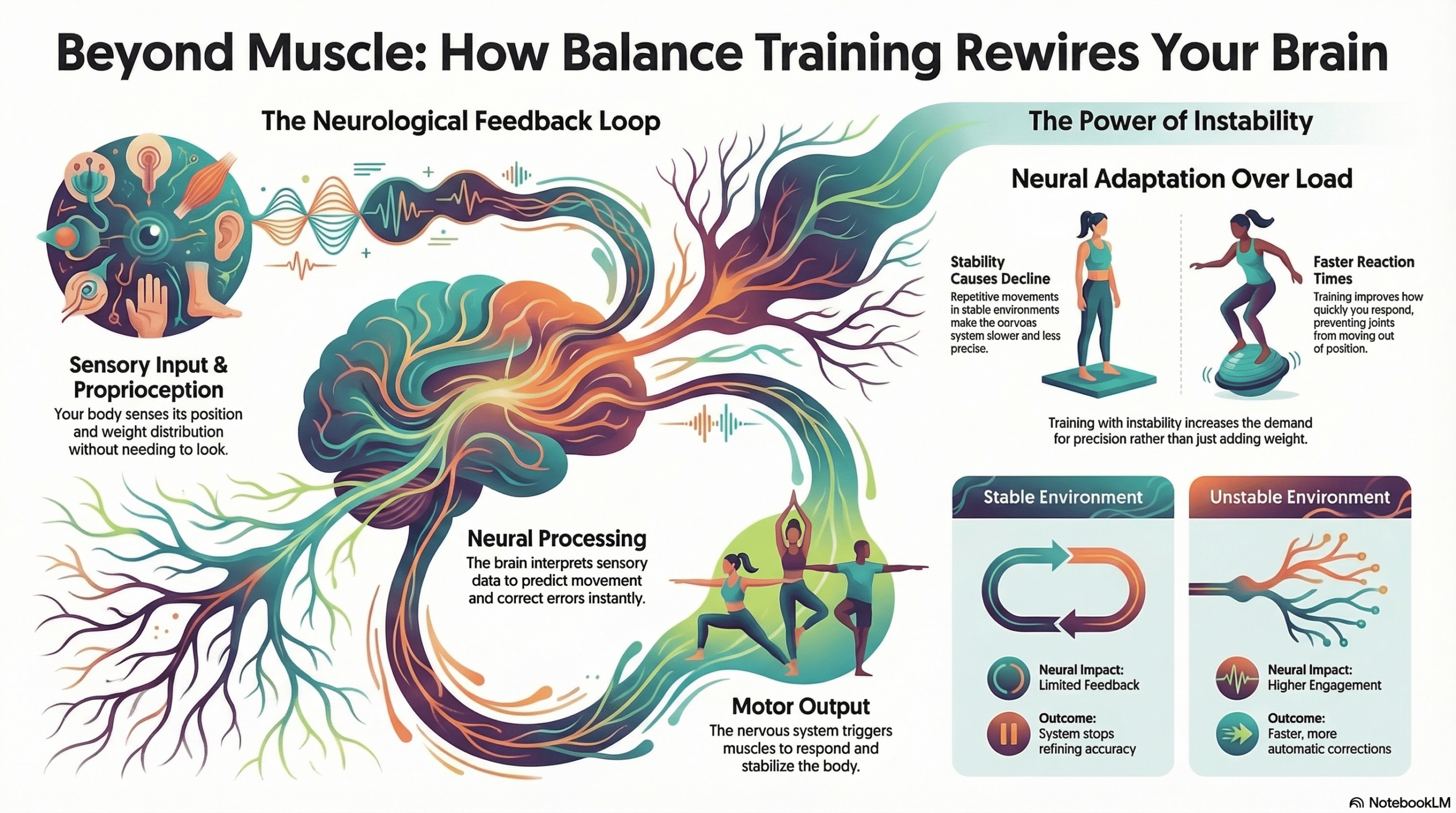
Balance is not primarily a muscular skill. It is a neurological process. Every time you try to stabilize yourself, your brain is detecting position, predicting movement, and correcting errors in real time. This loop is what balance training develops.
The System Behind Balance
Three systems work together:
- Sensory input — what your body feels
- Processing — how your brain interprets it
- Motor output — how your muscles respond
If any part is slow or inaccurate, balance fails.
What Is Proprioception?
Proprioception is your body’s ability to sense its position without looking. It tells you where your foot is, how your joints are aligned, and how your weight is distributed.
When you close your eyes and lose balance, you are exposing weak proprioception.
Why Most Adults Lose It
Proprioception declines when it is not used. This happens because movement becomes repetitive, environments are stable, and the nervous system is not challenged. Your brain stops refining accuracy. The signal becomes slower and less precise.
What Balance Training Actually Does
It forces your brain to:
- Process instability faster
- Reduce reaction delay
- Improve signal accuracy
- Coordinate multiple joints at once
This is neural adaptation. Not just physical training.
The Feedback Loop
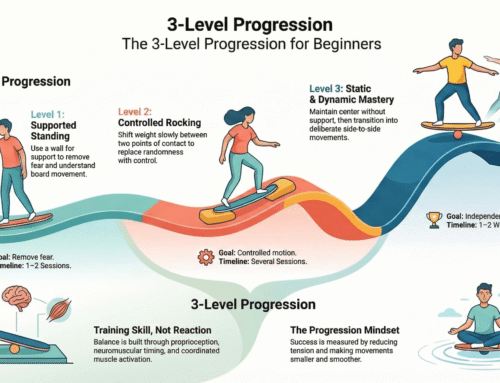
Balance training creates a constant loop:
- You shift position
- Your body detects it
- Your brain processes it
- Your muscles correct it
This happens continuously. With repetition, the loop becomes faster, more precise, and more automatic.
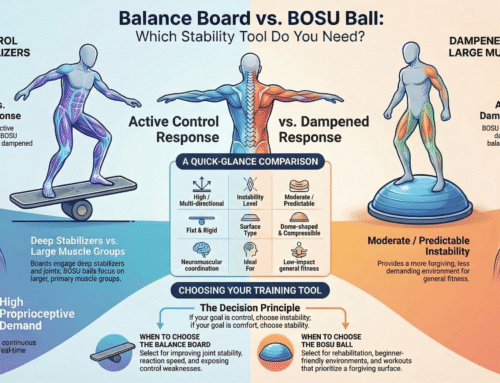
Why Instability Is Required
Stable environments limit feedback. There is no need to adapt. Instability creates unpredictable input, constant correction demand, and higher neural engagement. Without instability, the brain has no reason to improve.
The Role of Reaction Time
Balance is largely reaction speed. If your response is delayed, joints move out of position, control is lost, and compensation occurs. Training improves how quickly you respond — not just how strong you are.
Why This Improves Coordination
Better neural control leads to:
- Smoother movement
- More efficient force transfer
- Reduced unnecessary tension
- Improved body awareness
This affects all physical activity. Not just balance tasks.
Where Equibalance Fits
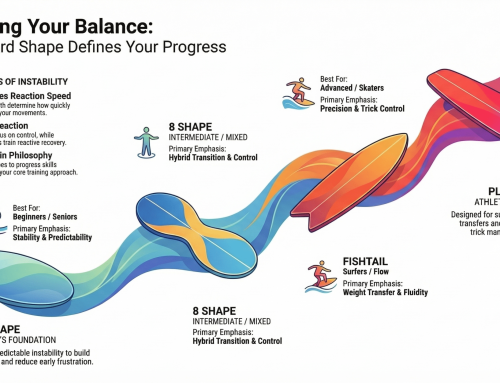
Equibalance creates the type of instability the brain needs. It provides:
- Continuous, unpredictable input
- Immediate feedback on movement errors
- Repeated exposure to correction cycles
- Progressive difficulty without chaos
This accelerates neural adaptation — not by adding load, but by increasing the demand for precision.
Why This Matters Beyond Fitness
Improved neural control affects:
- Movement efficiency
- Injury resistance
- Coordination under pressure
- Overall physical confidence
These are system-level improvements. Not isolated gains.