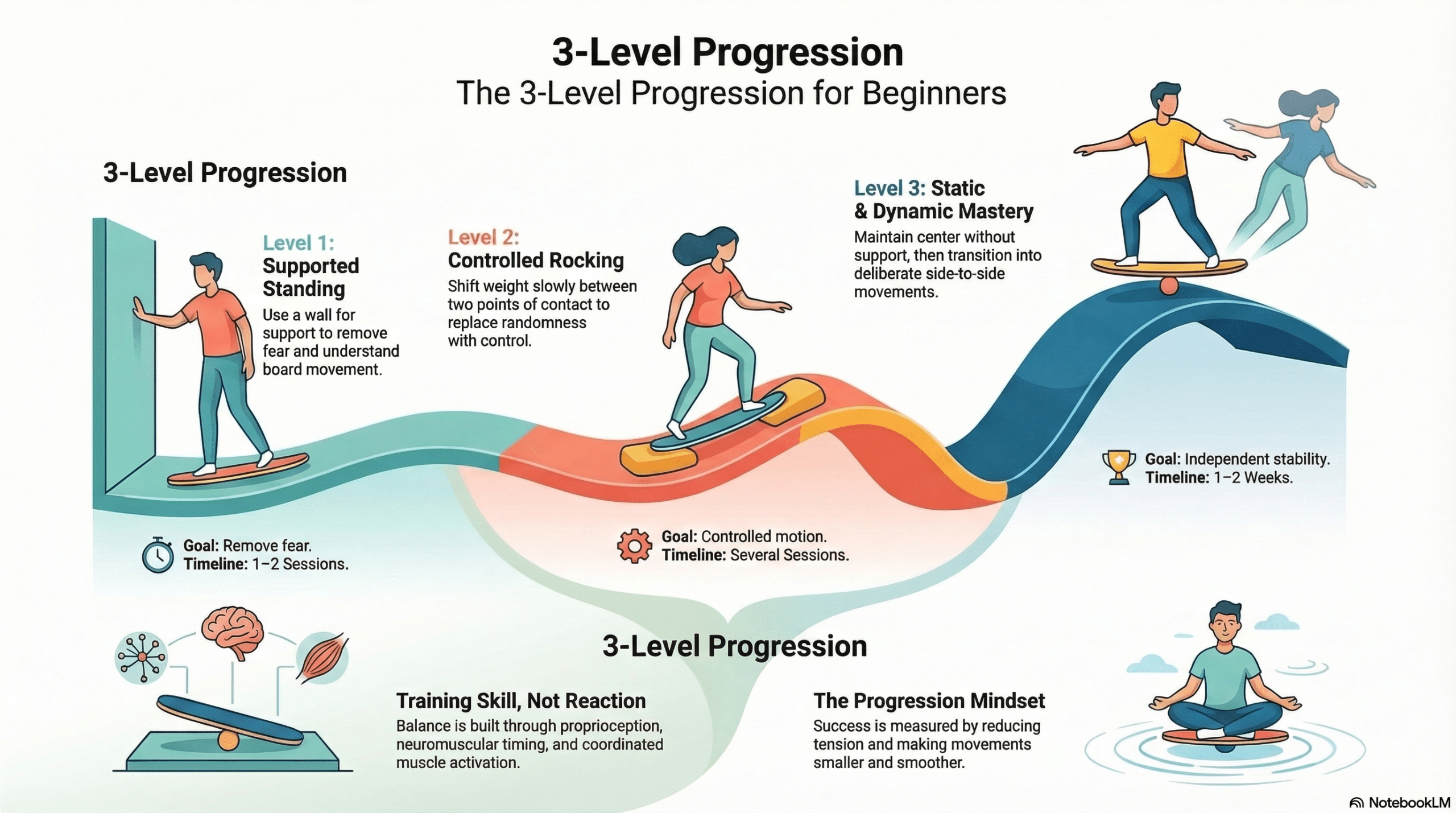
Most beginners fail at balance boards for one reason. They start at the wrong level.
They try to balance immediately, lose control, and assume the product is difficult. The problem is not difficulty. The problem is sequence.
Why Most Beginners Get Stuck
The common pattern looks like this: step on the board, try to balance immediately, overcorrect, lose control, repeat. This creates frustration, tension, and poor movement patterns.
Balance is not learned through reaction alone. It is built through progression.
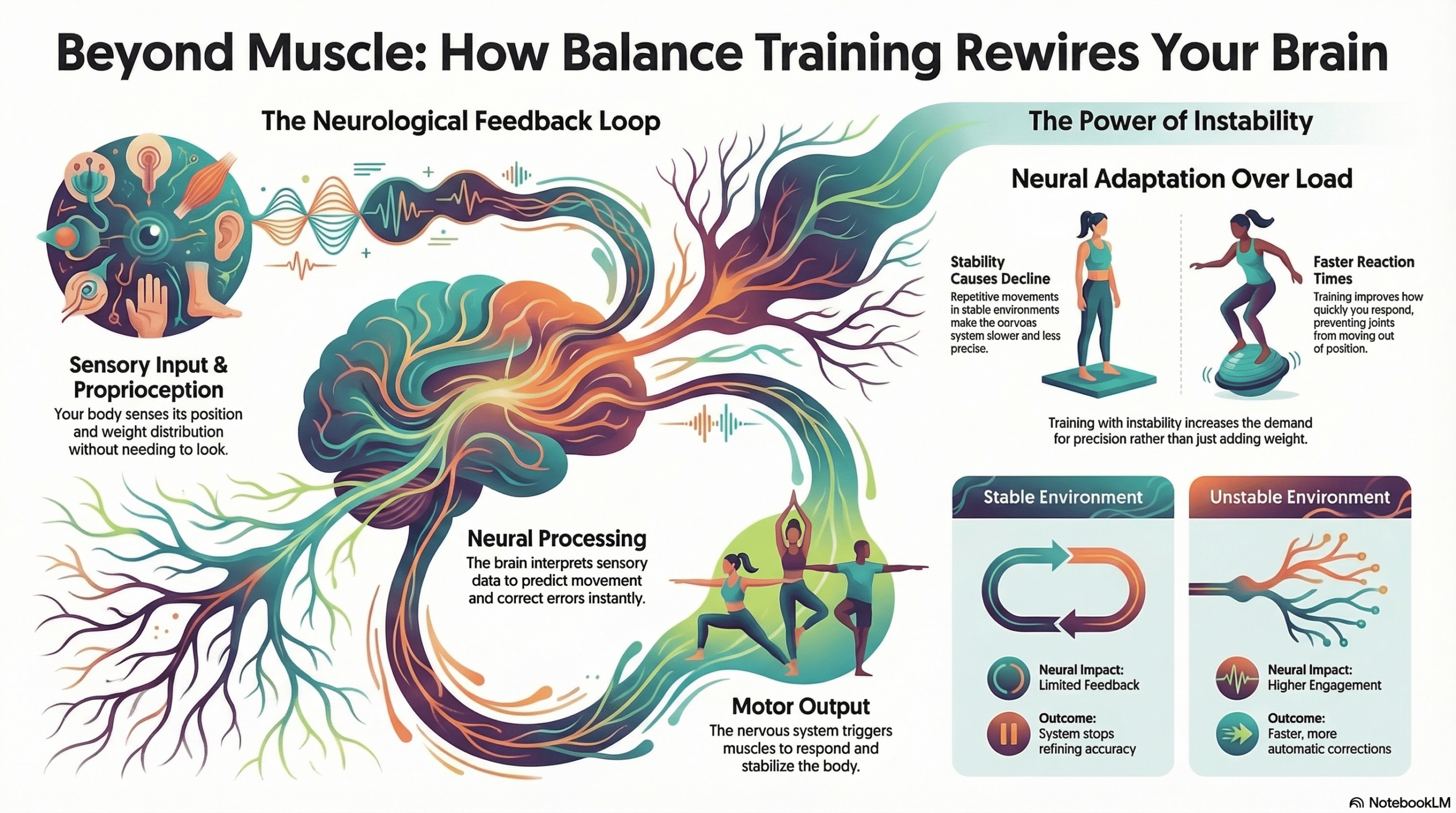
What You Are Actually Training
Balance is not a single skill. It is a combination of:
- Proprioception
- Neuromuscular timing
- Joint control
- Coordinated muscle activation
Each of these must be developed in order.
The 4-Level Beginner Progression
This is not optional. Skipping levels slows learning and increases frustration.
Level 1 — Supported Standing
Execution
- Stand on the board
- Hold onto a wall or stable surface
- Focus on staying centered
Goal
- Remove fear
- Understand how the board moves
What You Are Training
- Basic awareness
- Initial coordination
Level 2 — Controlled Rocking
Execution
- Keep two points of contact on either side of the pivot
- Shift weight slowly
- Control the board’s movement
Goal
- Replace randomness with controlled motion
What You Are Training
- Movement awareness
- Directional control
Level 3 — Static Balance (No Support)
Execution
- Stand without support
- Keep the board centered
- Avoid large corrections
Goal
- Maintain stability without external help
What You Are Training
- Stabilizer engagement
- Reaction control
Level 4 — Controlled Transitions
Execution
- Move the board deliberately
- Shift side-to-side
- Keep movement slow and controlled
Goal
- Stay in control while moving
What You Are Training
- Dynamic stability
- Coordination under motion
How Long Each Level Takes
There is no fixed timeline. Progress depends on consistency, control, and your ability to reduce unnecessary movement. As a general guide:
- Level 1 → 1–2 sessions
- Level 2 → several sessions
- Level 3 → 1–2 weeks
- Level 4 → ongoing refinement
Speed is irrelevant. Control determines progression.
Signs You Are Progressing Correctly
- Movements become smaller
- Corrections become smoother
- Tension decreases
- Control improves without effort
If you feel rushed or unstable, you skipped a level.
Where Equibalance Fits
Equibalance is designed to support this progression. It allows you to:
- Start with support safely
- Control movement at low intensity
- Progress without sudden instability
- Repeat drills without loss of control
This makes progression predictable. Not random.
Common Mistakes
- Skipping Level 1
- Trying to “balance” instead of control movement
- Moving too fast
- Training to fatigue instead of precision
Balance improves through control. Not repetition alone.
Balance is not achieved. It is built — step by step.